Programmieren Tutorium 12
Collections
Gliederung
- Iterator
- The Collection Framework
- Utility-Klassen
Iterator
Übersicht
- Entwurfsmuster aus der Kategorie Entkopplungsmuster
- Ermöglicht sequenziellen Zugriff auf Elemente einer Datenstruktur ohne die innere Struktur zu kennen
- Interface
boolean hasNext()E next()void remove()(optional)
Beispiel
private final class ListIterator implements Iterator<T> {
    private Element current;
    private ListIterator() { current = head; }
    public boolean hasNext() { return current.next != null; }
    public T next() {
        if (hasNext()) {
            current = current.next;
            return current.value;
        } else throw new NoSuchElementException();
    }
    public void remove() { throw new UnsupportedOperationException(); }
}
The Collection Framework
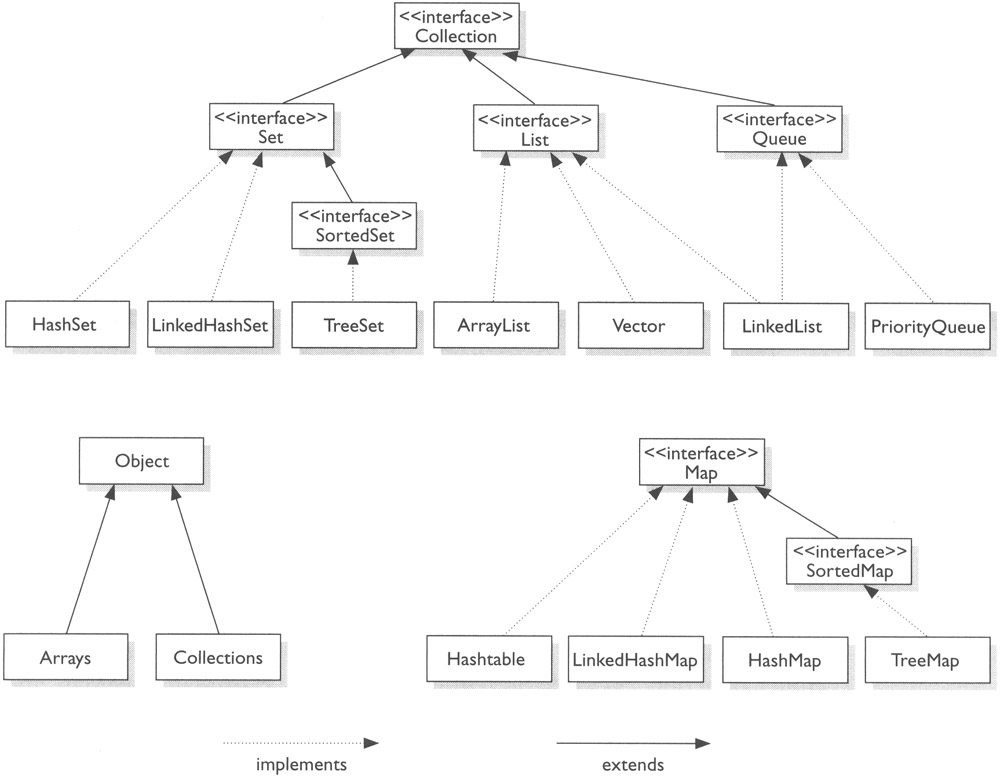
Overview
Iterable
public interface Iterable<T> {
    /**
     * Returns an iterator over a set of elements of type T.
     * @return an Iterator.
     */
    Iterator<T> iterator();
}
interface Collection<E>
- Erbt von
Iterable - Modelliert eine Sammlung von irgendwas
- Bietet Methoden wie
boolean add(E)boolean remove(Object)boolean contains(E)int size()- …
- Keine direkten Implementierungen
interface List<E>
- Erbt von
Collection - Modelliert eine geordnete Sequenz von irgendwas
- Fügt Methoden für indizierten Zugriff hinzu
boolean get(int)boolean set(int, E)boolean add(int, E)boolean remove(int)int indexOf(Object)- …
- Implementierungen:
ArrayList,LinkedList, …
interface Set<E>
- Erbt von
Collection - Modelliert eine Menge im mathematischen Sinn
- Enthält folglich keine Duplikate
- Keine neuen Methoden, jedoch gewisse Zusicherungen
- Implementierungen
Set=>HashSet,EnumSetSortedSet=>TreeSet
Queue und Deque
Queue- Warteschlange (z.B FIFO, Priority)
- Implementierungen:
LinkedList,PriorityQueue, …
Deque- Double-Ended-Queue, erbt von
Queue - Implementierungen:
LinkedList,ArrayDeque, …
- Double-Ended-Queue, erbt von
interface Map<K,V>
- Jeder
keyverweist auf einvalue - Es werden immer Paare von
keyundvalueeingefügt - Enthält keine doppelten
keys - Implementierungen
Map=>HashMap,LinkedHashMap(Zugriff inO(1))SortedMap=>TreeMap(Zugriff inO(log n))
Utility-Klassen
class Collections
void reverse(List<?> list)
void shuffle(List<?> list)
T max(Collection<? extends T> coll)
boolean disjoint(Collection<?> c1, Collection<?> c2)
Collection<T> unmodifiableCollection(Collection<? extends T> c)
class Arrays
void sort(Object[] a)
void fill(Object[] a, Object val)
List<T> asList(T... a)
int binarySearch(T[] a, T key, Comparator<? super T> c)
Task
Write a method that takes a string and returns the number of unique characters in the string.
The method should cache the results, so that when the method is given a string previously encountered, it will simply retrieve the stored result.
Feierabend!